This essay was published originally in Spanish and translated to English. It was publiched in April 2025 in the 5th edition of the Argentinian magazine Anchoa. The illustrations were done by artist and educator Rosaura Rodríguez.
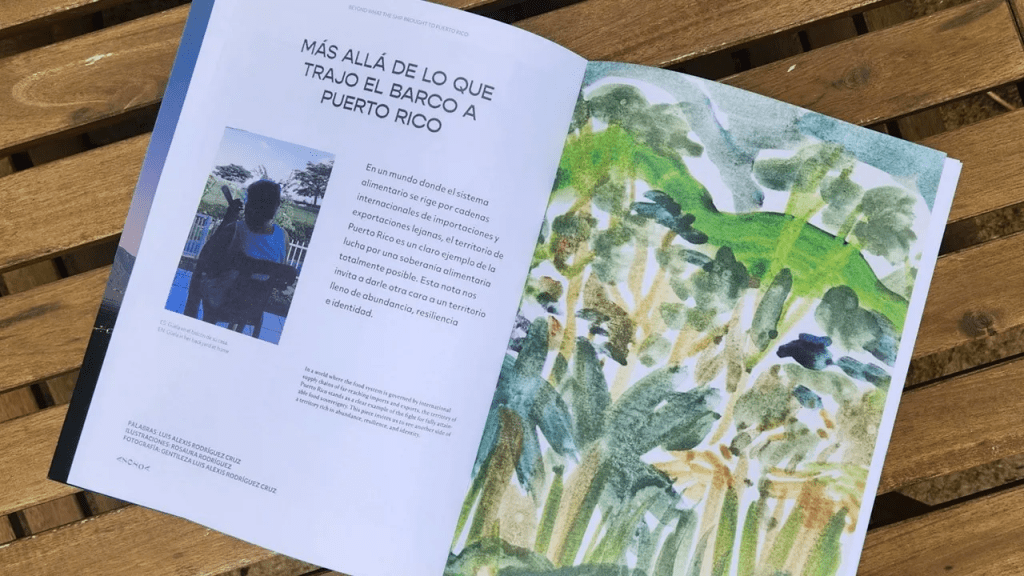
“You eat what the ship brought,” my grandmother would tell us when, upon arriving home from school, our 5 o’clock meal was the same thing we had for lunch in the school cafeteria: rice and beans . 1 That phrase or saying, which she and many people in Puerto Rico repeated and continue to repeat, reflects something common to the islands: our dependence on imports. Today in this Caribbean country where I live, around 85% of the food 2 consumed by its residents is imported. We are born with U.S. citizenship, since we are an unincorporated territory of the United States of America. Like eleven other islands in our region, it does not appear on the United Nations list of island states. The rice and beans my grandmother made for me (and the one I eat today) are made with rice from China and canned beans from elsewhere. You eat what the ship brought , yes, but not necessarily.
When I was little, I remember eating that dish with some disappointment. I wanted something fried, something from a fast food restaurant : chips and nuggets . But there were, let’s say, special confections that my grandmother made from time to time, like sweet and savory corn guanimos, cooked in boiling water, wrapped in banana leaves. And coming home from school and finding that was lovely. I ate them with gusto… There was no disappointment, although in later years that disappointment only increased. I no longer wanted to eat guanimos or funche—another dish made with corn, coconut milk, and spices—nor did I want rice and beans, or many other things we might call Puerto Rican or Afro-Caribbean. Much of our cuisine has African foundations, techniques and ingredients that were combined with others native to the American continent and Spanish colonization. I wanted to eat dishes that didn’t make me feel poor. Don’t let them make me feel like I grew up in a farming community in southern Puerto Rico, in the home of a grandmother who raised piglets to sell at Christmas. My head was filled with feelings and thoughts that promoted the detriment of my own.
I hug that child who grew up in the 1990s, in a Puerto Rico that seemed thriving. Buildings, coliseums, trains, foreign chains arriving, dollars here and there: ideas were built that we were the best in Latin America. And some of those ideas promoted that what was foreign, that what was American, was better than what was Puerto Rican. But the foundations of those constructions were made of lies and bad decisions that led us to a national bankruptcy that persists today and has resulted in displacement and precariousness. A corruption brewing in San Juan, in which US laws, regulations, and decisions have been complicit. In the 1990s (and even before), I think it was normal for a child from the countryside to want to «be more,» to escape «poverty.» That Puerto Rico or the government of that time avoided talking about or working to resolve that state, which is a reflection of vulnerabilities, injustices, and structural inequalities that have little to do with individual actions. But what would a child playing among banana trees and flying kites on a cattle farm know about that ?
It was one afternoon at school (I think I was in third grade, it must have been around 1998 or 1999), when we had to take some departmental tests, that I began to question whether or not we were poor in my house. The teacher mentioned a list of names, including me, and said something like: «You mark ‘below the poverty level.’» That’s the category that has to do with a household’s annual income. Whether it’s below the average the government assigns to determine whether a family is poor or not. I remember doubting that; I didn’t feel poor. But it sank in; I began to question and compare myself. I also began to look with disgust at my grandmother’s cooking. Because my friends who «weren’t poor» didn’t eat what she cooked with such care. I come back: I hug that child – I feel some shame when I remember that, some guilt for insolent things I may have said, for refusing to eat the dish made by someone who is no longer physically with me today.
I think about that as I sort through the recipes my grandmother wrote for me. I have about twenty of them, written in her own hand. They include her recipe for guanimos and funche, for pasteles 4 and sancocho and domplines, and of course, for her rice and beans. They’re in a little notebook I gave her many years after that afternoon in elementary school. I gave it to her in 2017, a year that lives in the memory—I dare say—of all those who are Puerto Rican, who have lived in Puerto Rico, or who have some connection to these Caribbean islands. It was the year that the powerful Hurricane Maria made landfall in Puerto Rico. Its sustained winds of around 249 km/h blew the roof off the house where we grew up. My grandmother could no longer cook there.

I was away from Puerto Rico, studying, when that happened. I arrived at the San Juan airport one November afternoon. The sky looked as if it were still recovering from the lashing of the strongest hurricane to make landfall in eighty years. My sister picked me up, and we drove through gray areas; the characteristic green of the tropics became a rarity in those months. The cars, many, many, including my sister’s, had a Puerto Rican flag sticking out of the front window. We arrived at my aunt’s house, where my grandmother was; it was the only one of the three houses on the family property that hadn’t lost its roof. That land was a farm in the last century, but like many others, it was converted into a built-up area in the 1950s. During that time, the «Commonwealth of Puerto Rico» was formulated, an «agreement» between the United States and Puerto Rico to promote autonomy. During that time, industrialization and the transition from an agricultural economy to one of services and manufacturing, to another plantation-based economy, were promoted. So there, on the marquee, feeling the fresh air that was beginning to arrive that month, was my grandmother, doing her crusades, missing the pet she lost and the house where she had lived for more than sixty years.
I can still hear her say, «Oh, my little house,» as we hugged. I had left Puerto Rico for the first time in August, a month before Maria. It seemed as if I had been away from this archipelago longer. After shedding a few tears and telling me that, she asked if I was hungry. I said yes, even though I wasn’t. She loved to cook for others. She didn’t make rice and beans, but she did make yams that my uncle had just harvested, with fried pork that a neighbor had given her, which she had in turn received from a farmer in the neighboring neighborhood. Stories like that multiplied across our islands. Yes, the hurricane’s winds made visible the persistent inequities and injustices that influence the vulnerability people experience, as disasters are never natural. Some 2,975 people died in the five weeks following the hurricane. I lost people close to me. Disasters are never natural, I repeat. But also, in part, and I speak for myself, they made visible how productive and abundant our islands are. We don’t necessarily have to eat what the ship brought in.
Of course, food insecurity skyrocketed after the hurricane. And before its arrival, about a third of our population lived in that state. That’s something that, in Puerto Rico and in many other places, doesn’t exist due to production or the amount of food available. It has many aspects, the amount of food available being one of them. The point here is that it’s possible to sustain our diet with more products from Puerto Rico and our Caribbean region . 6 Furthermore, if due to a hurricane or other shock , the few ships that anchor in our ports aren’t able to arrive, there is food that is produced here. Not long ago, in the 1980s, Puerto Rico produced almost half of its food.
The child I once was would have looked with disappointment at that plate of boiled yams with fried meat my grandmother served me, which she cooked on a stovetop, as there were no more stoves. As the years went by, during my adolescence and youth, I gradually shed those prejudices and preconceived ideas that were planted in me at a time when we weren’t called a «colony.» Understanding and reading about our past and present, thanks to the education and teachers I had in the public school system, made me value our dishes and confections. It made me challenge the idea of »poor man’s food,» which is sometimes even served on a table during Puerto Rican Heritage Week, as a typical dish, an object that is no longer common. Before returning to school, motivated by her and her family, I gave my grandmother a notebook. I look at the recipes she left behind. I prepare them for myself, for friends and family, and I treasure them. Today, through my work and writing, I explore the social dimensions of agriculture and fishing. And I believe that interest was cultivated by my grandmother.
It’s worth noting that the «Free Associated State» of Puerto Rico doesn’t have much say in deciding its supply routes, in achieving treaties, or in ways to protect local production, which has to compete with highly subsidized imported products. That’s why it’s more appropriate to talk about «food sovereignty» rather than «food security.» So today, to a large extent, I still eat what came on the ship. Yes, I still eat imported rice and beans, although not every day. But it’s clear to me that it’s necessary and important to have a sustainable and productive local agri-food system to feed ourselves. And there is the possibility of safeguarding it, even within the sociopolitical reality in which we live. All we need to do, as a society, is to begin to let go of those ideas that make us overlook and ignore the environment in which we are immersed. An environment that has the capacity to be abundant. True, there isn’t much influence, but it exists. And that influence must be used to benefit local production.
Deciding what to eat on these islands has many dimensions. Many people don’t have the privilege or the opportunities to decide, even. I was fortunate that throughout my childhood, there was always a plate of food, even though it could be categorized (or I was at that time) as «poor people’s food.» A plate of sancocho or rice with beans isn’t «poor»; it’s «Puerto Rican,» «Boricua,» «Caribbean,» «Afro-descendant.» But as my grandmother also used to say, «Whoever is given rice with beans every day also gets tired.» Within my means, I try to expand the recipes she left me and add more. You can make so much with a plantain, beyond tostones, arañitas, or mofongo. And little by little, we are learning about recipes, ingredients, and products that are and have been part of our islands, but that have been denied. Every time I discover something, I ask my beloved Güela for her blessing. There’s a lot to cook here, a lot to do, a lot that doesn’t come on a boat. 🐟

Footnotes
- Beans, also known as porotos in different parts of the American continent.
- The national consensus is that, in general, 85% of food is imported. This also describes the raw materials for many products. However, this figure is being re-evaluated, as it is thought (and I think) to be lower.
- This is what comets or kites are called in Puerto Rico.
- National dish made from various tubers and stuffed with some meat, typically pork. It can also be vegetarian. These are wrapped in banana leaves and cooked in boiling water.
- This number is the result of an independent study conducted by George Washington University, commissioned by the Puerto Rican government. Another study, by Harvard University, estimates that the death toll may have reached 4,065.
- See the conclusion (p. 157) of “Adaptive Capacity And [un]natural Disasters: Puerto Rican Farmers’ Adaption And Food Security Outcomes After Hurricane Maria” (University of Vermont, 2022).

Deja un comentario